
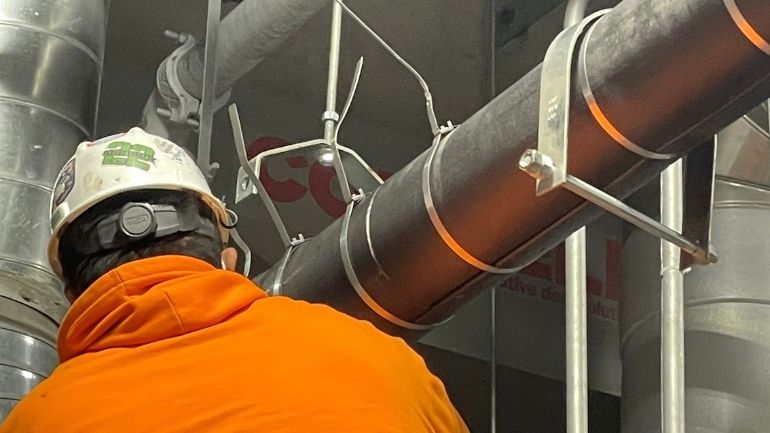
Traditionally, industrial insulation for piping networks has been made from pliable sheets of fiberglass, mineral wool, calcium silicate, perlite, or cellular glass. Professional insulation contractors wrap the sheets around pipes and fixtures, and then wrap them with a layer of metal jacketing. These thin sheets of aluminum or stainless steel cover the insulation core to provide mechanical protection against weather, physical impacts, and general wear, and installers use metal straps to hold the layers together and to the underlying structure. Finally, seams and overlapping joints are sealed using specialized tapes, mastics, or weather-resistant caulk.
Once this system is in place, insulation errors are largely invisible; you have to remove and dismantle the entire multi-layer insulation envelope to discover what is going on beneath the outer jacketing. That means that a gap at an elbow, a thin spot at a pipe support, or an improperly sealed joint at a flange transition will rarely announce itself during installation walkdown. Instead, it will announce itself months or years later, as energy costs drift upward, corrosion findings turn up during pipe inspection (or worse, with a leak or other failure), or freeze events occur on lines that should have been insulated.
These types of adverse outcomes are consequential in terms of impact to operations, labor and material repair costs, downtime, and, potentially, process material losses. Because the connection between these types of failures and the initial installation errors that caused them is rarely made explicit, installation errors are more common than most project records acknowledge. That means preventing the errors from happening is seldom addressed in a systematic way. The risks become built-in, part of the baseline expectations of putting such systems in place, meaning that insulation contractors who may have done a poor job or used inferior materials for the application are rarely held accountable.
Dragon Jacket Insulation (DJI) has a different perspective on what facility managers should expect from industrial insulation. Rather than base insulation quality on a system that depends on the inherently inconsistent workmanship of individual contractors, DJI has engineered a solution that directly addresses the most common failure modes of the insulation itself. The result is a prefabricated insulation system composed of a foam insulation core encapsulated in a polyurea shell that is custom built to conform to the exact pipe and fitting architecture of a given piping network. Each monolithic component is fully waterproof, thermally stable, dimensionally stable, and reusable over a long operational life. The quality of each component is established at our factory rather than determined by an installer in the field.
Where Installation Errors Come From
Field-fabricated insulation installation is a skilled trade, and the best insulation installers produce consistent, high-quality work under good conditions. The problem is that industrial project conditions are rarely good in the ways that skilled craftsmanship requires. Installers work under schedule pressure. They work in confined spaces, at elevation, in temperatures that make careful material handling difficult. They work on pipe systems that do not always match the drawings, with material that arrives in bulk and must be cut and shaped to fit geometry that the drawings represent in two dimensions but that exists in three. And they work on fitting populations — elbows, tees, flanges, valves — where each piece is effectively a custom fabrication task.
Under these conditions, errors are more often not the product of installer carelessness; they are the product of an inherently flawed process that demands too much because it is carried out in an environment where workmanship is continuously compromised by time, access, and physical conditions. Gaps develop at elbow transitions because cutting foam or fibrous material to a precise miter angle by hand is difficult to do consistently. Thin spots appear at pipe supports because the installer had to work around a structural element and the insulation coverage on the far side of the support is not visible from the working position. Jacket seams open at flange connections because the jacketing material does not conform cleanly to the irregular geometry of the flange face and the installer’s seal did not hold through the first thermal cycle.
These are systemic errors produced by a systemic process problem. Addressing them requires changing the process, not working at the fringes.
Geometry Established at the Factory, Not the Job Site
The most direct way that prefabrication reduces installation error is by resolving geometry before installation begins. At DJI, a prefabricated elbow component is manufactured to match the specific geometry of the pipe elbow it will cover — the pipe diameter, the bend radius, the wall thickness of the insulation — with dimensional accuracy that field cutting cannot reliably achieve. The installer does not need to calculate a miter angle, cut material to that angle, and hope the result fits cleanly. The component fits because it was made to fit.
This matters for thermal performance because insulation thickness at fittings is where field-fabricated systems most commonly fall short of specification. For example, an elbow insulated with field-cut sections that do not fit cleanly at their mating edges will have reduced thickness at those edges, and the edges of an elbow are exactly where the pipe geometry concentrates heat loss, because the outer radius of the bend has more exposed surface area per unit of pipe length than the straight sections on either side. Thin insulation at the location of highest heat loss is not a minor performance deviation. It is a systematic underperformance that compounds across every fitting in the system.
Prefabricated components also eliminate the measurement errors that accumulate in field fabrication across large pipe populations (and which cause temperature losses to aggregate over a single run). On a project with hundreds of fittings, the probability that some percentage of field-cut insulation pieces will be cut to the wrong dimension — wrong diameter, wrong length, wrong miter angle — is effectively certain. Each of those errors produces either a gap in coverage or an area of crushed and compressed insulation where an oversized piece was forced into place. Factory manufacturing eliminates both error types because dimensions are controlled by tooling rather than by tape measure and hand saw.
Moisture Barrier Continuity Without Field Sealing
One of the most significant categories of insulation installation error involves the moisture barrier — the layer that prevents water from reaching the insulation core and the pipe substrate.
In conventional jacketed insulation systems, the moisture barrier is assembled in the field from jacket sections, lap joints, sealants, and tape. Every lap joint is a potential moisture entry point if the overlap is insufficient, the sealant is improperly applied, or the joint opens under thermal movement. Every penetration through the jacket for a support rod, a strap, or an instrumentation connection is a potential entry point if it is not properly sealed. Every termination at a flange, valve, or equipment connection is a potential entry point if the end detail is not carefully executed.
The number of field-assembled moisture barrier details on a large industrial insulation project is substantial, and each one depends on correct execution by the installer. Inspecting all of them is practically impossible — many are inaccessible after adjacent work is complete, and the consequences of a failed seal are not visible until moisture has been entering the system long enough to produce detectable damage.
In contrast, prefabricated encapsulated insulation eliminates the entire problem of field-assembled moisture barrier errors. DJI’s polyurea outer shell is applied to each component in the factory as a seamless, continuous barrier across the entire surface of the component. There are no lap joints in the encapsulation, no field-applied sealants, and no penetrations through the barrier that were made in the field. The moisture barrier is complete when the component leaves the factory. Field installation connects components to neighboring components according to a designed interface without having to create a moisture barrier from scratch. Because each component is monolithic, installation is fast and does not require special tools or training.
The connection between adjacent components is designed as part of the component interface rather than left to installer judgment. The reduction in moisture barrier error probability that results from this shift — from hundreds of field-assembled details to a small number of designed interface connections — is one of the most significant performance advantages of our prefabricated encapsulated systems over conventional field-fabricated alternatives.
Consistency Across the Pipe Population
In field-fabricated insulation systems, installation quality tends to vary, and those variations are difficult to detect or correct. The first fittings installed on a project tend to receive more careful attention than the fittings installed at the end of the project, when schedule pressure is highest. Fittings in accessible locations receive better coverage than fittings in confined or elevated locations where the installer’s physical access is constrained. Fittings that an inspector reviewed during installation walkdown tend to be better executed than fittings that were covered before inspection occurred.
The result is a network where insulation quality can be correlated to factors that have nothing to do with thermal or moisture protection requirements, and where the worst insulation tends to be at the locations that are hardest to access, which usually means the locations that are also hardest to inspect and remediate later.
Prefabricated components, however, are built to spec regardless of location within the piping network. They produce consistent performance across the pipe population because consistency is a property of the manufacturing process, not the installation process. An elbow installed at the end of a long project day in a confined pipe rack receives the same insulation geometry, the same wall thickness, and the same moisture barrier continuity as the elbow installed on day one in an open and accessible location. At most, time pressure and accessibility only affect how quickly and comfortably an insulation component is put in place, not how the component delivers performance once it is secured.
Reducing Rework and Its Hidden Costs
Rework is among the most expensive outcomes of insulation installation error, and it is more common than project post-mortems typically acknowledge. When an inspection identifies inadequate insulation coverage at a fitting, or when a jacket seam is found to have failed during a commissioning walkdown, the cost of remediation includes not only the material and labor to correct the specific deficiency but the access cost to reach it, the scheduling impact of holding other work while insulation rework is completed, and the documentation burden of capturing the deficiency and its resolution in the project quality record.
On projects where insulation rework is identified late — after adjacent equipment or structures have made the deficient location difficult to access — remediation costs escalate further. Occasionally, an insulation deficiency identified during commissioning or early operation may be accepted as tolerable rather than corrected, because correction at that stage is prohibitively disruptive. Those accepted deficiencies become the foundation of the long-term performance problems the facility will manage for the next decade.
Contact Dragon Jacket to Discuss Our Solution to Insulation Installation Errors
Prefabricated industrial insulation systems reduce both the frequency and severity of installation errors. A component that fits accurately, encapsulates completely, and connects to adjacent components through a designed interface rather than field judgment produces fewer inspection deficiencies, requires less rework, and delivers a completed installation that more closely matches the specification intent than a comparable field-fabricated system installed under the same project conditions.
If you are managing an industrial insulation project where installation quality, schedule reliability, and long-term performance are priorities, or if you have dealt with the downstream consequences of installation errors on past projects and want to understand how prefabrication can change that picture moving forward, discover the solution offered by Dragon Jacket Insulation.
Contact Dragon Jacket Insulation today to request a quote, speak with an engineer, schedule a demonstration, or review the installation of our product in the field. We can walk you through the specs of the product, our installation process, and the performance differences that prefabrication delivers in practice.